
Q&A: Shaun Went on how virtual trades training boosts job site performance
The veteran welder is launching a digital trades training platform to benefit new workers.

After working globally as a welder, Shaun Went settled in Canada five years ago. He began to wonder why digital training methods that have benefitted thousands overseas weren’t being applied to the next generation of tradespeople here.
To fill the gap, he’s partnered with Interplay Learning to launch Virtual Trades, which aims to bring immersive, simulation-based trades training to employers, training providers, unions and community organizations across Alberta and Saskatchewan. We caught up with Went to chat about how digital training can impact new workers and why competency should mean more than time.
SiteNews Editor Russell Hixson: I haven’t seen a lot of this kind of training for trades work. I was really really curious to better understand where virtual reality and augmented reality is right now when it comes to trades training and what the process has been like to develop that.
Shaun Went: There are a whole lot of very specialized companies that do specialized training utilizing VR and AR. There’s a lot of safety content out there as well. However, the niche market for us is the skilled trade section. There are not a lot of companies that are focusing on this, although it really is a hot topic in the market in Canada today. Unfortunately, to develop this content takes years. We’ve partnered up with a couple of companies. One of the biggest ones being Interplay Learning in the U.S. They have a huge huge library. That’s why we’re able to offer this in a really good package to the Canadian market.
It took us quite some time to get things in order and align it. The content is different from the US to Canada. But what we’re trying to teach is not so much the codes. In fact none of the codes. It’s more about the process that people need to follow to be able to do something in a safe manner and complete the task correctly. We teach competency rather than certificate. The content is recognized by the IACET which is a global governing body for secondary education.
We’re trying to build a competent, safe workforce that can get to site and contribute to that ecosystem long before they are red seal certified. I phoned WCB and they told me that a huge amount of the accidents are between the ages of 16 and 24. There’s a cost implication not only to the individual but to the company and to the country as a whole. We’re all saying Mark Carney did really well at saying these huge investments are coming to Calgary, coming to Alberta, coming to Canada. He’s 100% right. It’s a great ecosystem to be part of. The problem is that we still need people to build. We are trying to partner up with traditional learning pathways and institutions to bolster that learning so that when a student is coming out of there, they are able to pass and not be so reliant on site experience. Typically on a big construction site, you might be there for two years, but you might only do four or five tasks in those two years. And then you go to your test and you fail because you just don’t have that experience. In Canada, we have a really high failure rate in trades. We have a really high dropout rate in trades.
Tell me a bit about how you came to this space.
I’m a welder by trade. I started off my career in the UK. Then moved back to South Africa. I am South African. I got into rebar in the early 2000s and then part of that journey was always managing big projects, managing people and there was always a huge demand in the industry for those skills and it got worse when I came to Canada. I was like ‘holy moly’ what’s going on here? And part of that is because we do accreditation based on time and not by competence. A lot of other countries do competency-based training. When I came here, I wanted to get re-certified in welding. I quickly realized how much bureaucracy and red tape there was. So I worked in rebar. I did some really cool projects. The BMO here in Calgary, some of the Ring Road projects. I was part of some high rises. I was part of the tallest building in Africa on the rebar side, but really it was a pain point that I had because there were just not enough skills around to meet the country’s demands or my project demands. So that’s where it all came from.
I read that there’s 17 trades that you’re targeting.
So there’s 17 trades course categories. Automotive, appliance repair, clean energy as a category, right? Rather than an actual trade. But also HVAC, electrical and plumbing are by far our three most robust platforms. But we also have things like cranes and rigging. And we have a full section on career exploration for the K9-12 learners. We’ve just launched a section on data centers, that really targets what skills data centers are going to require. There’s going to be a huge demand. We only have a very small pool of resources. So, how are we upskilling our labor forces to be able to meet those demands? AI is going to change some things, but there’s there’s a huge amount of vacancy in in the trades
So you’re not just looking at what the industry reads needs right now. You’re looking into the future, what it’s going to need years down the road.
Absolutely. There were some investments just announced from Meta with the data center coming to Alberta. That’s going to take a huge amount of resources out of this pool. The new pipeline that we’re talking about again, a huge amount of resources of the home-developing infrastructure building pool are going to go towards that. In Canada there’s been some BuildForce reports out ranging from 380,000 to 550,000 people short in the Canadian ecosystem for skilled trades by 2030 to 2034. And that’s driven largely by lack of interest in the trades and retirement.
What does it look like? The nuts and bolts of this digital training?
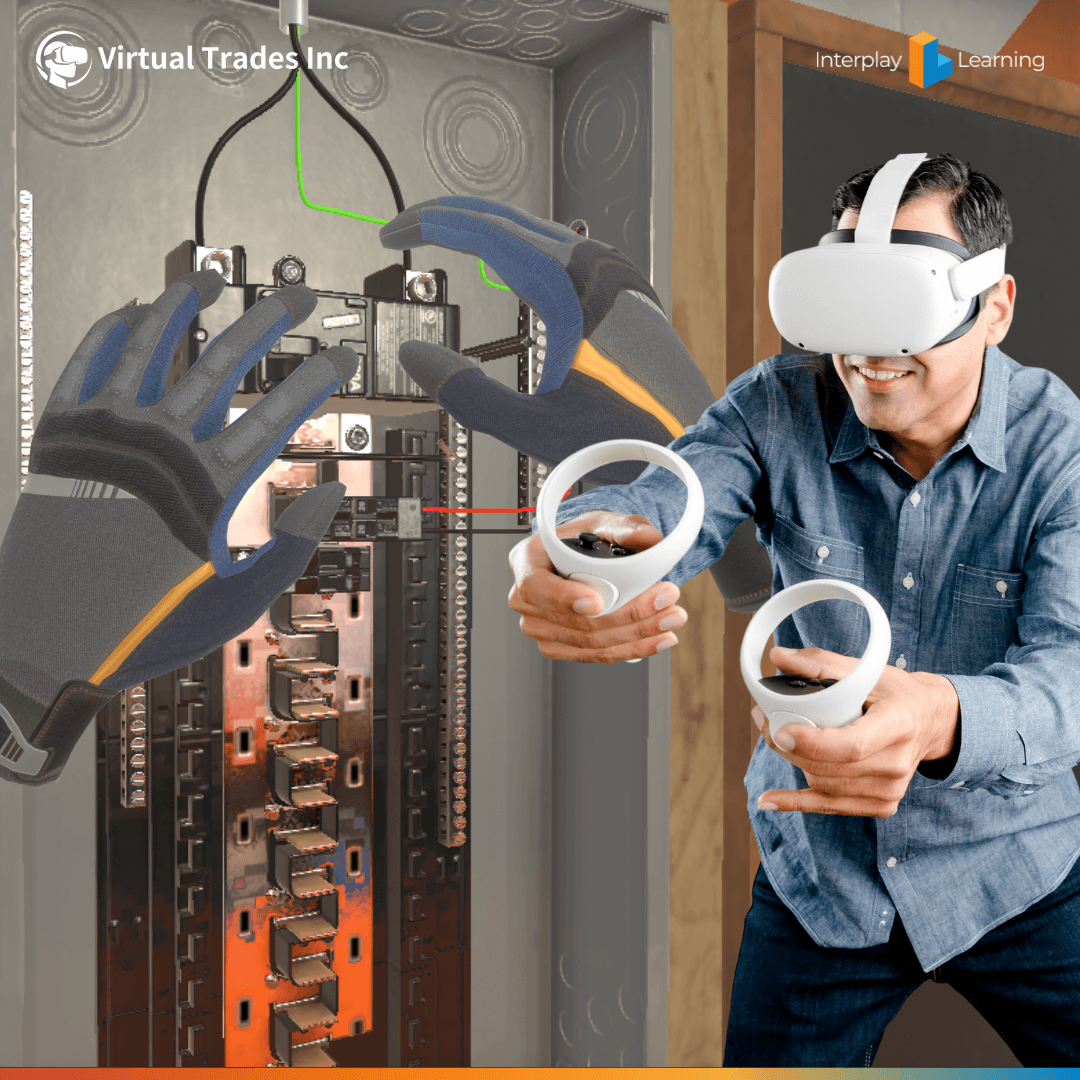
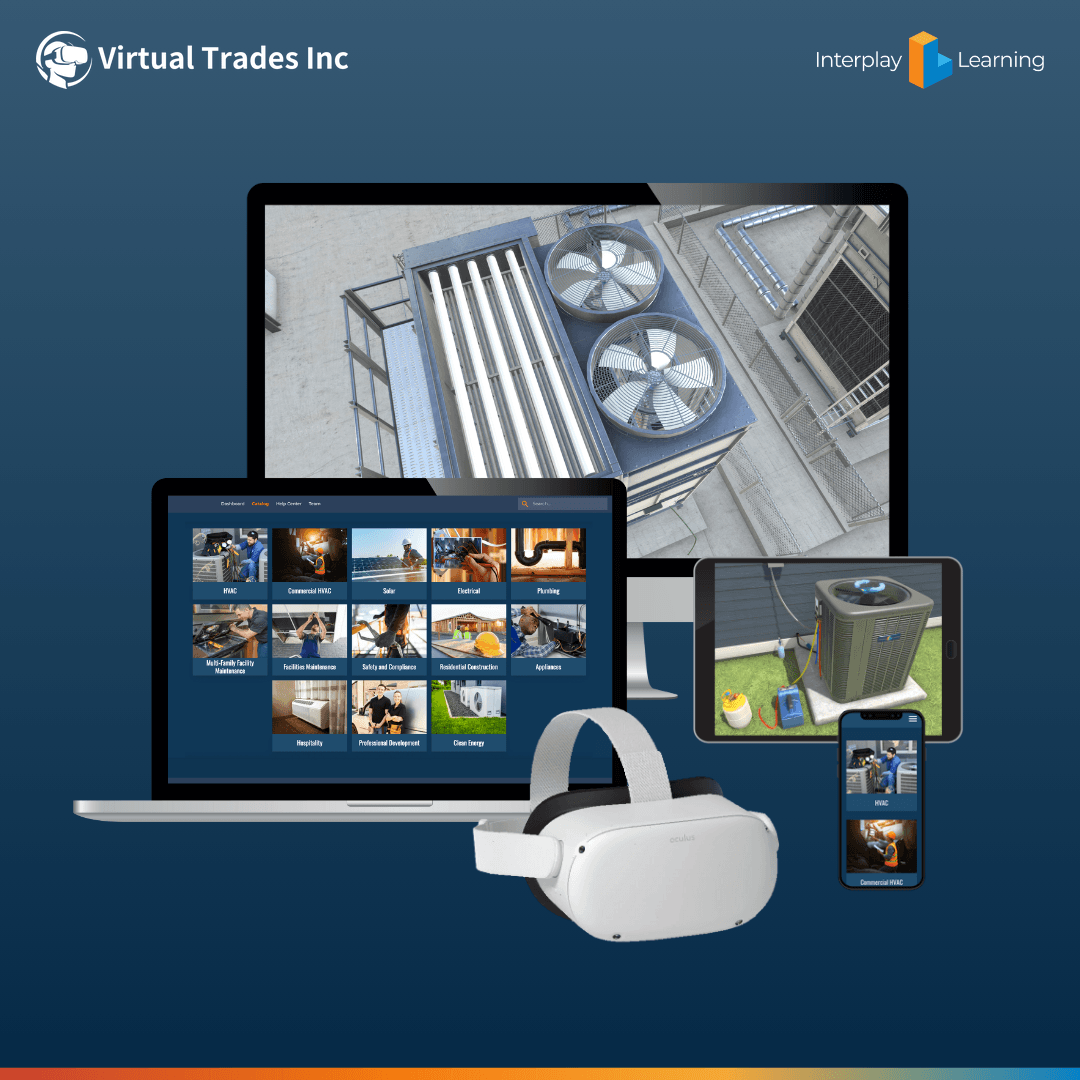
It’s device agnostic. You can start off with a computer screen. You can go to an iPad. But there’s a huge portion that is VR simulated where you have to physically move and interact with your screen, which is really, I think, from a retention of information point, really important. So, you don’t need a VR headset. Although personally I find it a lot sexier from a trades learning perspective. A learner will start off in a pathway. They’lll go through a whole lot of safety courses. And then, depending on their skill level, they can do basics like how to use a multimeter, how to use a nail gun, things like that. Really basic fundamentals. And then it can go into more serious simulations. One of them is chiller troubleshooting for an HVAC unit. You walk into a room and there’s a message on a screen saying we’ve received a fault. Please diagnose this fault. And you’ve got to actually go through the process. There’s three elements to this. One is where we’re teaching you the process to follow. The second one is a challenge mode where we give you a clipboard so you can follow certain tasks but we don’t give you the answer. And then the third portion is you walk into a room and it’s a test environment. There is no help and you have to get a 80% on that score to be able to pass. Once you pass we give you a certificate of completion and there is an accreditation value assigned to that task.
One of the some of the big issues that I’ve seen in covering the industry is there’s not enough seats for people who want to become tradespeople. And oftentimes for some trades, those seats are concentrated in places like the Lower Mainland of B.C. or other urban centres.
A lot of our training is confined to bricks and mortar and the access to those bricks and mortar. And this is where this is a real differentiator. We’re not trying to take over that market. We’re trying to enhance that market. So a learner can come to a current institution, be it a union hall or a SAIT or any of those institutions, pre-prepared. So they’ve done their simulations they’ve they’ve worked on the process that needs to be followed. The second part is removing some barriers. So, throughout my whole entire career, I’ve been really focused on allowing people to learn in the way they want to learn, number one, but also allowing people to learn regardless of their location. Why shouldn’t a woman that’s up in Northern Alberta be able to go through the same quality of education as someone down in Calgary? And understanding that there are limitations to that statement, what we’re trying to do is give them access to all that information so that at least when they come down to Calgary, they’re prepared. They can spend less time in that institution potentially and their learning curve is accelerated.
One of my big questions is why hasn’t this been done before? It seems like an obvious problem to solve.
It was obvious to me, I suppose, but it took a long time to get there. I think Canada traditionally has just been a slow adopter to these kinds of technologies. Globally my partner down in the U.S. has over 16,000 companies that are signed on to this. They’ve trained over 550,000 people. It’s not that this is a new technology. It’s been tried. It’s been tested. It works. It’s just that Canada really hasn’t adopted it as quickly. I can’t tell you why. I’m still new to Canada. I’ve only been here five years. For me it was about trying something different. I think a large portion of why we do it the current way is because our training model is based on time. A lot of countries in the G20 have moved away from that model. Once you can prove proficiency and you go to an institution and say I want to take a test on arc welding and you prove that you can arc weld. They give you a stamp in what is effectively your blue book or certificate to say you’re able to arc weld. That does two things. It accelerates things so that people who can learn quickly are able to become higher paid individuals that contribute more. But it also allows the companies to not have such a restraint on trades development and trades demand because they have more access to those people coming through because they can train faster.
What is your vision for the future of training and skill development in Canada?
I would love to see Canada moving towards more of a competency-based model. It allows people to develop more. I don’t like the idea of having to change a toilet for a year to prove that I can change it. If I can do it in 10 days and go and do a test, why should that not allow me to develop and earn more and contribute more to society? And pay more taxes so we all can benefit as a nation. I would love to see Canada moving more towards that. But I’m not on the political side. I just want to help people learn. I want to help people grow. I want companies to have access to a greater pool of individuals that can work safely.