
After decades of quiet evolution, modular’s moment has arrived
There’s reason to believe that following its quiet rise, modular is set to reshape how Canada builds everything.
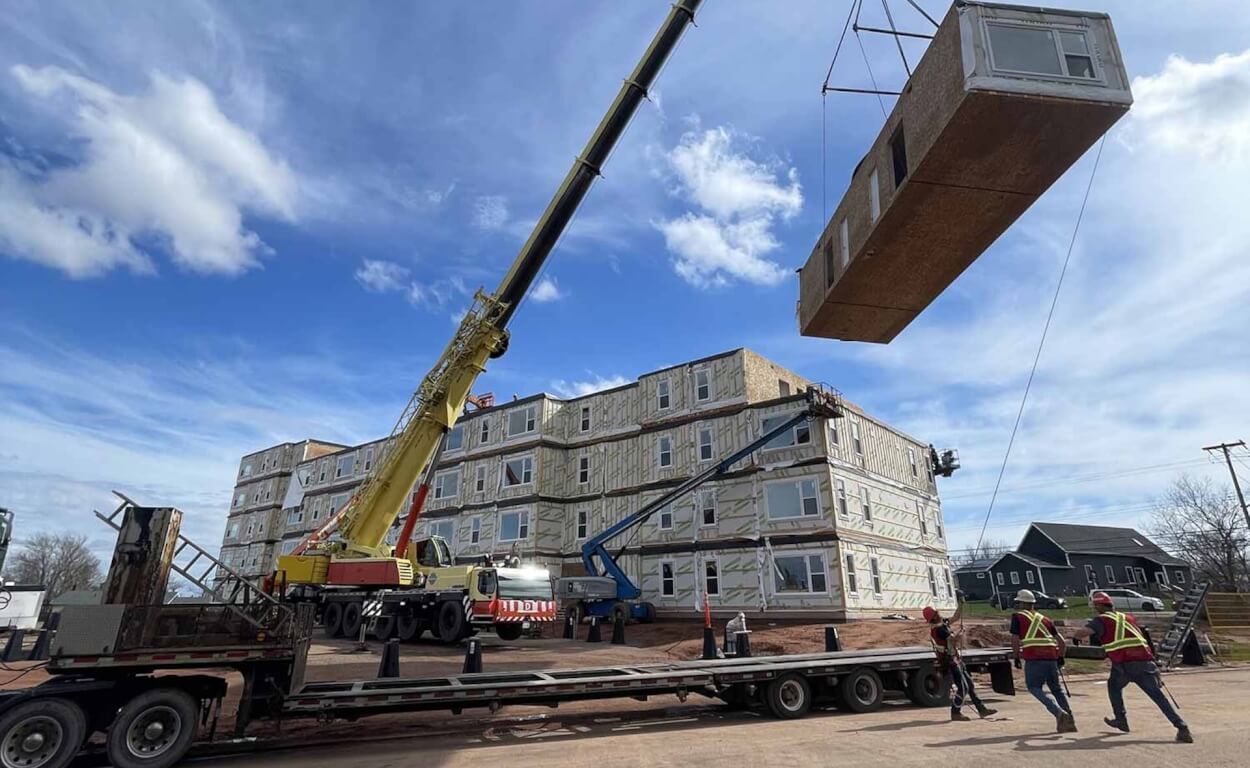
Complex modular construction in Canada didn’t emerge from a design studio, nor a housing policy. It came out of the oil sands — and there’s reason to believe that following its quiet rise from the muskeg, the industry is set to reshape how this country builds everything.
The evidence stretches back further than most people realize.
Single-family modular housing has existed in Canada for some 50-60 years. Meanwhile, the complex, multi-storey, multi-unit construction that’s gaining ground today is barely a decade old. Between those two eras sits a chapter the industry doesn’t tend to spotlight: the workforce camp.
As capital flooded into the oil sands through the early aughts, the industry faced a logistical reality: 10,000 workers don’t fit in hotels. The solution was modular workforce camps: multi-storey structures with shared kitchens, dining halls, and recreation facilities. Functionally, it was apartment-style living. And, without anyone fully appreciating it at the time, it was also a proving ground.
“The Canadian energy sector — the natural resource sector — is the reason why we have been able to do what we’re doing today,” explains Troy Ferguson, founder of 720 Modular, a volumetric modular design-builder with deep industry roots and an ever-growing Canadian portfolio. “The way we approach modular today really stems from this three-step trajectory that began decades ago: from single-family, to these work-camps, to today’s multi-family,” he says. “The work camps served as a foundation for what would become multi-family construction, but nobody realized it at the time, because the energy sector was so vibrant in Canada. There were billions of dollars invested, and that’s where the modular industry was building.”
Then, the music stopped.
Oil peaked in late 2014. Capital dried up. And the modular professionals who had spent years mastering large-scale industrialized construction suddenly found themselves without a market — but still with ample expertise, a robust network, and now, a country with a worsening housing crisis.
“I’ve learned that misery can promote some positive outcomes, as long as you have a positive mindset,” Ferguson said. “In this case, there were two miseries: one industry that had peaked and was now dying on the vine, and on the other hand, a depleting housing stock with a growing population.” And so, the concept of 720 Modular was born for multi-family housing.
“We brought these two misery moments together, and we created something positive.”
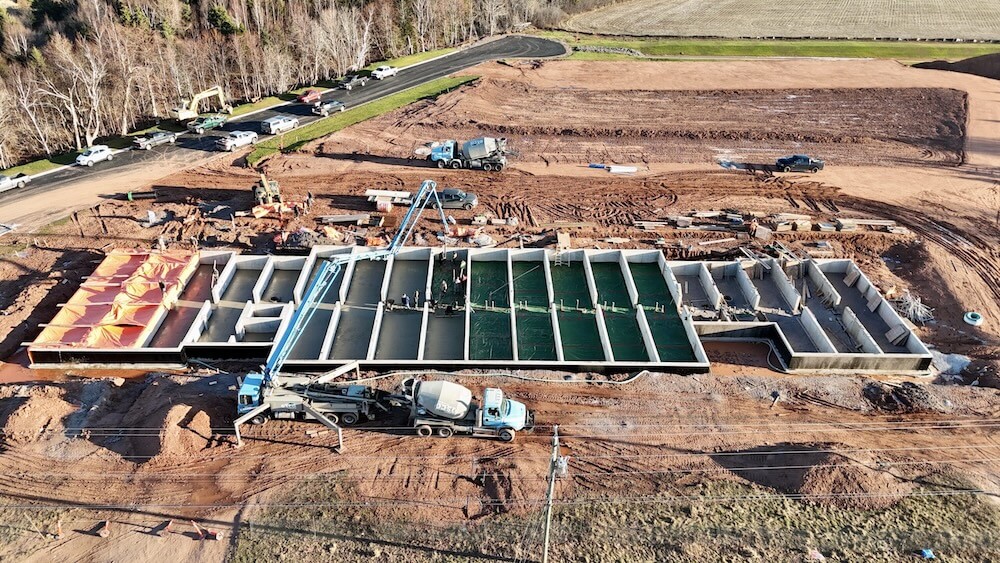

Images: 145-unit, 2-building Charlottetown, PEI project (720 Modular)
The pivot made sense on paper. The challenge, though, was that multifamily housing is a fundamentally different problem than a workforce camp. In the resource sector, standardization was a given — the same modules, the same layouts, optimized and repeated at scale. Multifamily housing has historically resisted that logic. Architects want something distinctive. Owners want something custom.
“Every building ends up being a snowflake,” explains 720 Modular’s vice president, project delivery, Craig Mitchell. But it’s undeniable: there’s beauty in the uniform. “Everyone is different, every project is different — what the modular industry is trying to say is: let’s get back to standardization.” The efficiency of this approach, Mitchell says, could move construction timelines up from years to mere months. This doesn’t just mean that home delivery happens faster, but it also plays into the financial investment. But more on that later.
Snowflake preferences aside, there’s also a structural mismatch the industry is still working through. Modular runs two project sites simultaneously — factory and foundation — but construction contracts, financing models, and housing legislation are built entirely around one site.
“The construction industry is not set up for two project sites ongoing at once,” Mitchell explains. “We want to provide the vehicles to help owners out in navigating these two sites.”
Until those systems catch up, the private sector is in a holding pattern. Right now, modular in Canada is almost entirely publicly funded, despite — as Mitchell notes — the private sector accounting for an estimated 95% of all housing construction nationwide. And it’s not because of pretend barriers: first, there’s this two-site problem. On top of that, there’s a perspective shift that needs time to buffer. See, modular isn’t exactly cheaper — yet. Upfront cash demands are notable, and CMHC-backed mortgages aren’t structured for multifamily modular delivery. But importantly, the cost for a developer to work via modular today isn’t equal to what it would cost that same developer to build with modular just a couple of projects down the road.
“The first building’s delivery might be a year or 14 months. The next building, we’ll deliver in nine or 10 months. And then, from there, we could be down to just six months,” Ferguson says. “That is really where the cost is going to come in line.”
The cost curve improves with repetition, if the repetition exists. For a private developer building the same apartment typology across several projects a year — featuring the same modules under the skin, with different exterior finishes — the learning compounds. After Project #1, the design is already done. The team knows the process. Each build is faster, tighter, and less expensive than the last, until modular costs come in line with those of conventional construction. And then below them.
“Costs average down over time,” Mitchell affirms. And it’s not just developers that should be thinking about the modular long-game.
“If you’re a general contractor, this is something you should be thinking about,” says Ferguson. “If you’re a developer, you should be thinking about this. If you’re a banker, you should be thinking about the future — how you’re going to align your business — because you hit fast-forward, and the landscape of how much offsite construction is done looks very different ten years from now.”
Outside residential builds, Mitchell notes that some of modular’s history may be poised to repeat itself. With major infrastructure announcements like pipelines and defence builds becoming a regular fixture, the demand for industrialized workforce housing could resurface. “I think we’re going to start potentially seeing that again,” he says.
Meanwhile, that fast-forward button isn’t needed to see Canada’s housing shortage problem; that’s a present-day issue, and the construction industry’s capacity to respond with conventional methods has its limits.
Modular has spent decades quietly building the knowledge, the logistics, and the track record to fill that gap. The infrastructure is there. The expertise is there. All that’s left is for the industry to get in the game.
Cover image: 720 Modular
This article was produced in partnership with SiteMedia Content Studio.