
Up there: What can Martin Berrigan teach us?
When Whitehorse needed housing, log cabins got taller.
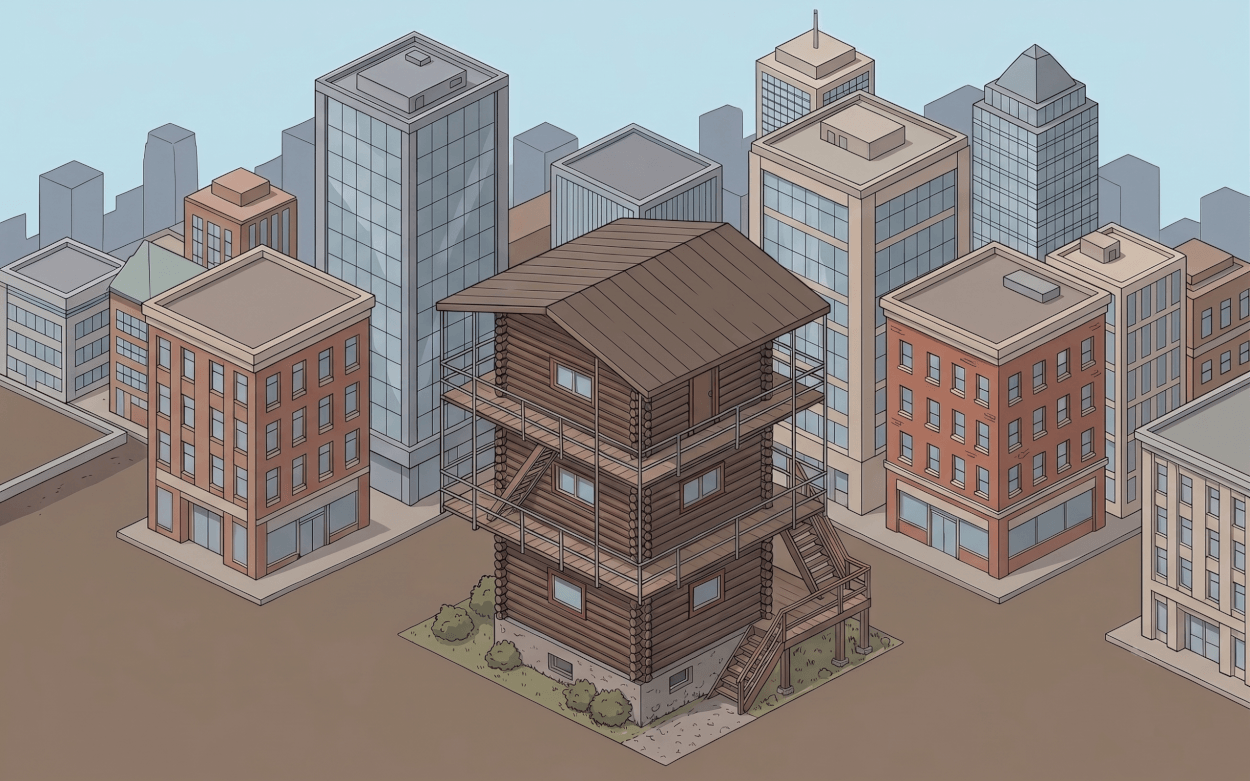
On Lambert Street in downtown Whitehorse, in the Yukon Territory, two multi-storey log buildings still stand. They are known as the log skyscrapers.
The name is a bit goofy. They are not skyscrapers. But they do serve as one of the better examples we have for the realities of northern housing, built in response to pressure that could not wait for the perfect plan.
In 2024, the Government of Canada released a national housing strategy titled Solving the Housing Crisis: Canada’s Housing Plan. The phrase “housing crisis” has since shaped policy, changed industry priorities, and put housing back at the centre of national discourse.
I hate to say “but” after a paragraph like that.
But.
In Canada’s North, the housing crisis has been unfolding for generations, and it is kind of our fault.
During and after the Second World War, Whitehorse was transformed by northern megaprojects: the Alaska Highway, the Northwest Staging Route airports, and the Canol Pipeline. Military personnel, construction workers, entrepreneurs, and new residents poured into the Yukon. Whitehorse was booming and soon it would become the territorial capital.
Does this seem familiar?
Too often we find ourselves talking about the state of northern housing as though the crisis is new. It is not. Going back to even the construction of the DEW Line in the Cold War era, we can observe the same basic sequence: major activity moves north – military investment, mining, transportation projects, government expansion, energy development, public infrastructure development – people begin to arrive before housing needs have even been understood and planned for.
The crisis becomes background noise.
There are many ways to respond to enhancing the quality and accessibility of housing in our North today. If you were Martin Berrigan in 1940s Whitehorse, you would make log cabins taller.
Berrigan, a Klondike-era prospector, responded to Whitehorse’s housing market pressure with a perfectly northern solution. His buildings were not elegant. They were not conventional. They were not supported by a policy or national strategy. But he got them built.
One of the log skyscrapers is a three-storey structure, only 16 by 16 feet. It was made from nine-inch logs set on 12-inch base logs and rose to a height of 58 logs. The logs were cut from the east bank of the Yukon River and hauled to the site by horse. Electricity and plumbing did not arrive until 1964. Drywall and a concrete foundation came even later.
The building had no vacancy before it had amenities. A one-star review on Airbnb, perhaps – but a housing solution, nonetheless.
Romanticizing the past is not a housing strategy. But dismissing the lesson would be a mistake.
Long before modern construction methods, sealifts or barges, ice roads, modular factories, architects, engineers, or construction managers, northern Indigenous Peoples built with what the land made available. Thule whalebone houses, built by the ancestors of modern Inuit, were semi-subterranean winter dwellings found across parts of the Canadian Arctic, Alaska, and Greenland.
They were excavated into the ground for insulation. Stone and turf formed the base. Whale mandibles and ribs became structural elements. Skins, sod, and turf created warmth and weather protection. They were not improvised shelters. They were sophisticated responses to climate, materials, mobility, food systems, and community life.
Major projects are once again lining up across the North. Many billions of dollars in public and private investment are required to support Canada’s next chapter in the Arctic. But if housing is treated as an afterthought, we will again be a part of the problem.
Communities will absorb pressure before capacity exists. Temporary accommodations will become semi-permanent. Costs will rise. Local residents will compete with project demand in an inflated market. Employers will struggle to recruit talent. Projects will become more expensive. And the phrase “housing crisis” will again become a polite way of describing our failure to plan.
Housing in the North is not somebody else’s problem. For governments, it is a responsibility. For industry, it is a condition of successful project delivery in a community. For investors, it is an opportunity. For individuals in northern communities, it is a matter of stability, dignity, and self-determination.
The solution is not one thing. It is not only modular construction, only public housing, only private capital, only staff housing, only Indigenous-led development, only camps, only affordable housing, only local materials, or only federal funding.
It is all of these, coordinated earlier and treated as essential infrastructure.
Let’s be really good at that during Canada’s modern northern Renaissance.