
Up There: Taking the long way
70 years after its inception, the Mackenzie Valley Highway is getting a major boost.
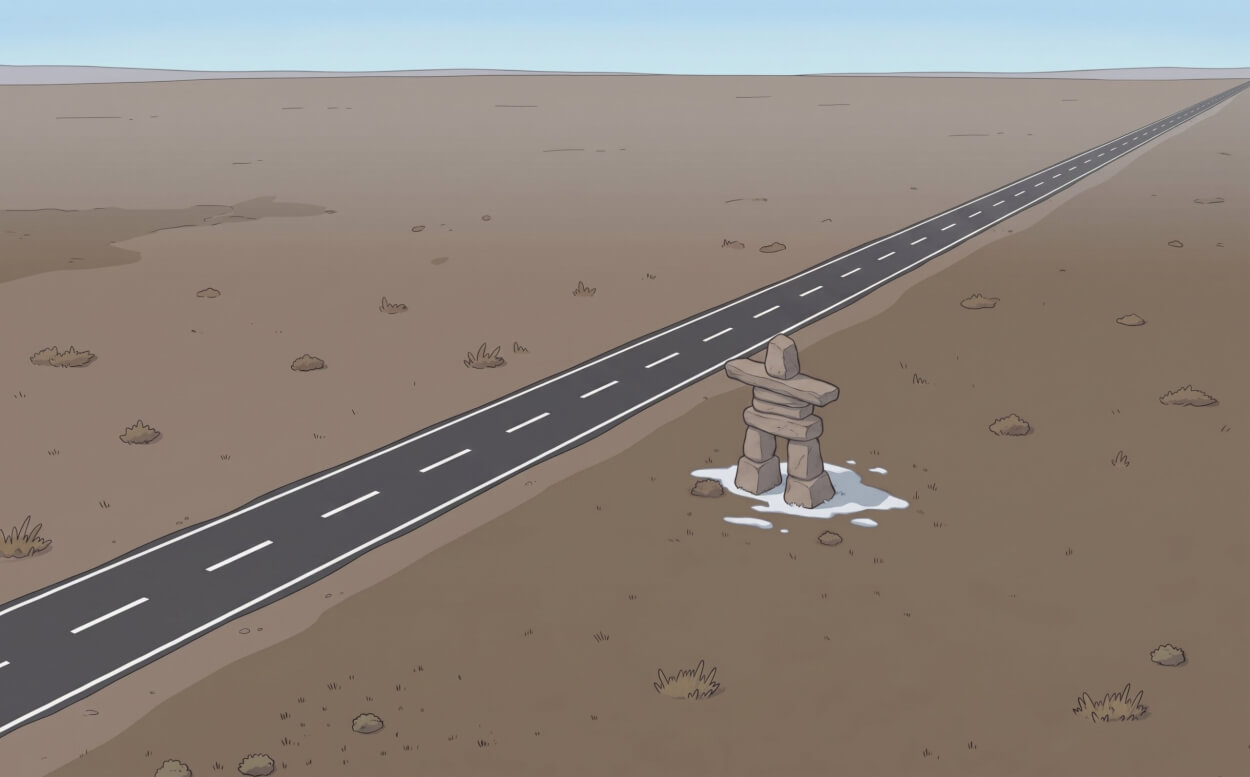
In 1977, Canada stopped building the Mackenzie Valley Highway 18 kilometres short of Wrigley. It took until 1994 to finish those last 18 kilometres. That is roughly a kilometre a year, if you count the years nothing moved. On November 5, Ottawa committed $3.1 billion through 2031 to build the roughly 800-kilometre extension from Wrigley to the Dempster Highway south of Inuvik.
The idea goes back to John Diefenbaker’s 1958 Roads to Resources program. Construction began at Fort Simpson in 1972. The name of the program tells you what Ottawa saw when it looked North. In 1977, Justice Thomas Berger’s inquiry into the proposed Mackenzie Valley gas pipeline put a different account of the valley on public record. Dene testimony documented how people lived on and used the land. Berger recommended a ten-year delay to allow Indigenous land claims to be settled. The pipeline and the highway were separate projects, but they exposed the same question. Who gets to determine the true purpose of a given development?
The intervening decades were hardly idle. In 2010, the territorial government and Sahtu Secretariat Inc. signed an agreement to advance planning. In 2014, the environmental assessment narrowed to the Wrigley–Norman Wells segment. This September, Ottawa committed $405 million for work including the Great Bear River Bridge near Tulita, the next phase of the Prohibition Creek Access Road and preliminary engineering for two more bridges. The November budget goes further. It commits to funding construction of the full corridor, whose northern alignment is still being developed with Indigenous groups.
For Tulita, Norman Wells and Fort Good Hope, the case for the road starts with the ordinary business of keeping a community supplied. Think of a contractor waiting for a replacement part, or a housing project that has to order a season’s worth of materials in one shipment. All-season access changes how much inventory a business has to carry and how much cash it has to tie up. Ottawa expects cheaper road freight. The real affordability test is whether the savings reach households. Maybe we should publish freight rates and track the price of a basic grocery basket before and after the highway is constructed. Perhaps then we can see who pockets the difference.
Ottawa also wants a better supply route to Inuvik as Canada expands its military presence in the Arctic. A second overland approach to the Beaufort Delta has strategic value. This gives Ottawa a reason to pay for the road through its working life. The budget commits federal support for some maintenance, with the terms still under negotiation. The agreement should spell out who pays when thawing permafrost deforms the roadbed, who clears the snow and how quickly a washout must be repaired. In my view, a federal government that claims the strategic benefit should carry a durable share of those costs.
Indigenous governments should have a hand in setting those terms, along with the alignment, access to harvesting areas, wildlife monitoring and the way construction is procured. Leaders in Wrigley have already made clear that consent has to be earned. Procurement is one place where Ottawa and the territory can show what they heard. Package work so northern firms can bid for jobs they have the equipment and crews to deliver. Structure apprenticeships around enough consecutive seasons for workers to earn their tickets. Give local firms a fair shot at the maintenance contracts that will still be there when the construction camps are gone.
There is also a decision to make about what happens when the road opens up land to more traffic and industrial access. A public highway can make it easier for a family to travel between communities and easier for outsiders to reach places that have been difficult to get to. The same culvert or access road can have very different consequences depending on who uses it and when. The people who hunt, fish and travel there should have the authority and resources to help set access rules and change them when monitoring shows a problem such as the drug trade and bootlegged alcohol.
Canada has spent nearly seven decades drawing this road North. Let’s get it done right.