
Up there: Roads to somewhere
Nunavut communities lack connection. That needs to change.
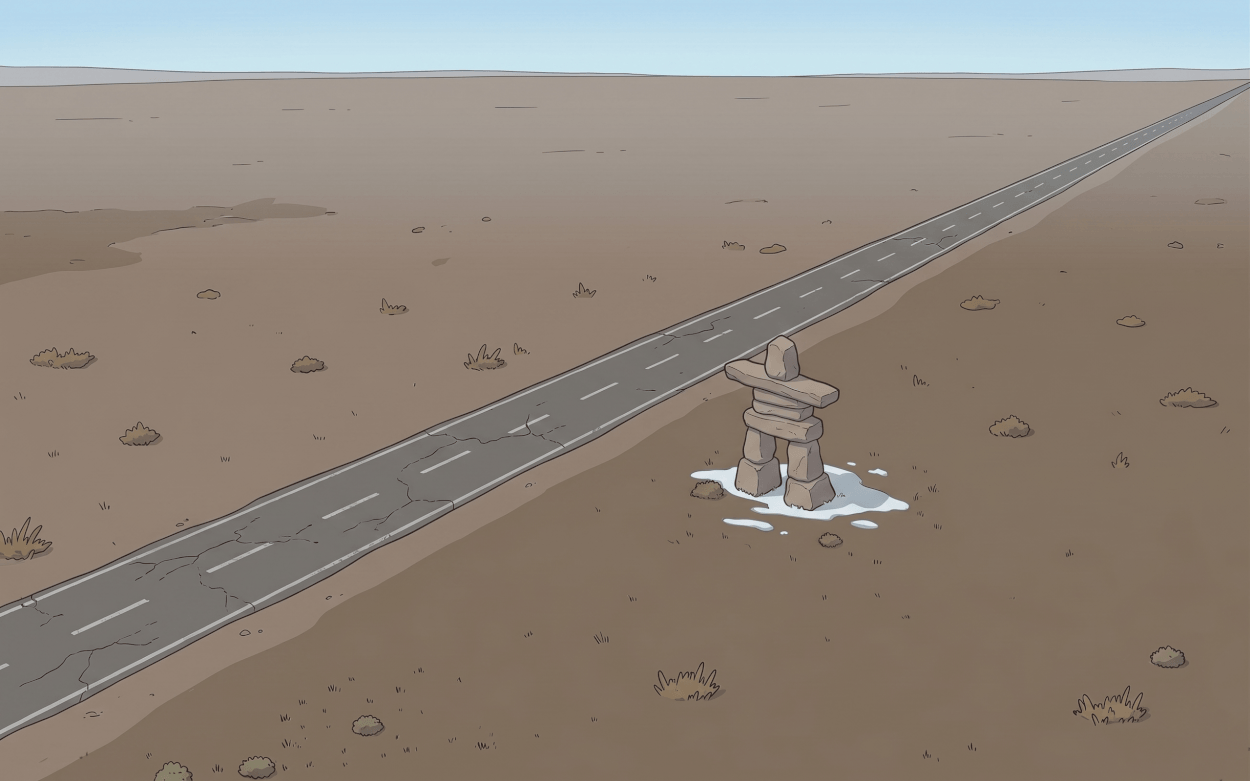
Canada’s northern map still contains vast blank spaces, not of surreal geography, but of basic infrastructure. Like roads.
Iqaluit’s “Road to Nowhere” has long been one of Canada’s favourite infrastructure punchlines. Built to reach a landfill that was never constructed, it simply ends on the tundra.
But the joke is no longer on the road. City planners in Iqaluit have embraced this road as an opportunity to shape the residential and commercial growth of the community.
If we judge the need for northern roads with the same spreadsheet we use to rationalize new southern roads, we will almost always conclude they should never be built. The disparity between Canada’s three territories tells the story.
The Yukon has nearly 5,000 kilometres of roads. Virtually every community can be reached year-round. The Northwest Territories has roughly 2,200 kilometres of roads. And since 2017, Canadians have been able to drive to the Arctic Ocean on the Inuvik-Tuktoyaktuk Highway. For perspective, Ontario has more than 250,000 kilometres of roads.
And then there is Nunavut.
Nearly two million square kilometres. One-fifth of Canada’s landmass. Twenty-five communities. 850 kilometres of roads and none connect one community to another.
Every Canadian can drive from Vancouver to Halifax but no Nunavummiut can drive to the next community.
A resident of Rankin Inlet cannot drive to Arviat for a job interview. A business in Cambridge Bay cannot truck supplies to Kugluktuk. A family in Iqaluit cannot take a bus to Pangnirtung for a celebration.
For too long, Canadians accepted this reality because there appeared to be little reason to challenge it. Aviation and seasonal marine transportation seemed sufficient, and conventional cost-benefit analyses rarely justified ambitious road construction projects.
The calculus has changed.
Roads underpin almost every ambition Canada now holds for the Arctic.
We cannot develop our resource economy without roads.
We cannot reduce housing costs when every building material arrives by air, river, or sea.
We cannot strengthen Arctic sovereignty while relying almost entirely on abbreviated runways.
We cannot talk seriously about food security while groceries move through one of the world’s most expensive transportation networks.
Roads are not transportation infrastructure. They are a necessary economic multiplier.
The Alaska Highway proved this premise more than eighty years ago. Built in 1942 with wartime urgency, it transformed the Yukon. Communities expanded. Tourism flourished. Mining accelerated. Supply chains became permanent. Entire industries emerged because people and goods could move reliably across the territory.
This one road transformed an entire region of our country. And you may not know this, but we didn’t even pay for it.
Today, infrastructure and sovereignty have become inseparable. Northern roads are no longer optional public works projects; they are strategic national assets.
Future historians may look back on this moment much as we now look back on the years before the Canadian Pacific Railway fulfilled Canada’s promise to British Columbia, once it joined the Confederation, to build our nation’s first transcontinental railroad.
The Road to Nowhere should remind us that the greatest mistake is not building a road that doesn’t make sense in a formal study. It is forgetting that roads often create the very opportunities later used to justify their existence.
Long before the dreamers and surveyors, and an industry like ours, the Arctic already had highways.
The caribou migrations. Hundreds of thousands in a given herd.
For thousands of years, vast herds have sustained cultures, communities, ecosystems, and economies. The ancient migration routes are still used by the caribou herds today.
Canada must build the infrastructure our North needs, and this includes roads, but we must also protect the pathways that made life in our Arctic so special in the first place.
Every kilometre of new road we hope to build carries a precious responsibility.
If you get the chance, go to Inuvik and drive to Tuktoyaktuk. You will know what I mean.