
Timeline: North Shore Wastewater from inception to settlement
What started out as $700M upgrade ballooned into a $3.86B quagmire for Metro Vancouver.
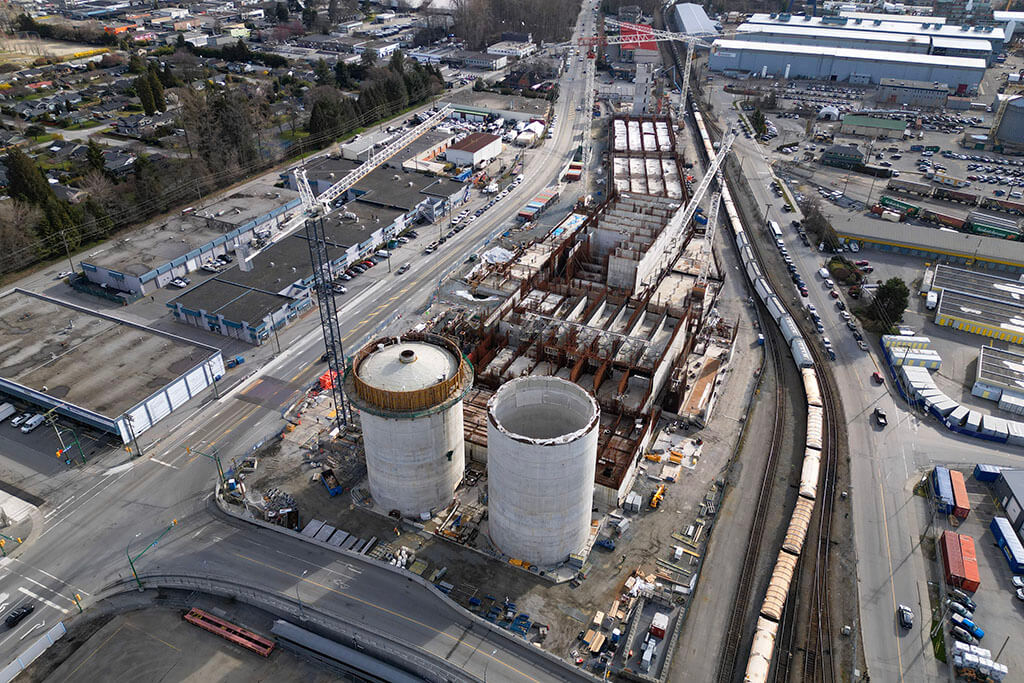
It was supposed to be a straightforward infrastructure upgrade for 300,000 North Shore residents.
But it became one of Metro Vancouver’s most expensive and legally contentious projects on record.
The North Shore Wastewater Treatment Plant — designed to replace the aging Lions Gate facility, one of the last plants on the west coast of North America still providing only primary treatment — was first announced in 2011 with a cost estimate of $700 million set in 2013.
Today that figure stands at $3.86 billion, the original contractor was fired and sued for $500 million, and the plant isn’t expected to open until around 2030. As of t his month, a settlement has finally been reached — but questions about how exactly it all went wrong remain unanswered.
2011 – 2013: Project announced
Metro Vancouver publicly announces plans to replace Lions Gate — one of the last primary-treatment-only facilities on the west coast of North America — with a federally compliant secondary treatment plant. The project is announced in 2011. By 2013 the regional cost estimate is set at $700 million. The plant is designed to serve over 300,000 residents and businesses across the Districts of North and West Vancouver, the City of North Vancouver, and the Squamish and Tsleil-Waututh Nations. Federal regulations announced in 2012 require municipalities to upgrade to secondary treatment, adding urgency to the project. The design calls for a stacked layout on a compact 3.5-hectare site with biogas energy generation, heat recovery, and odour control systems.
2017 – 2020 Acciona awarded design-build contract
Metro Vancouver awards the design-build-finance contract to Acciona Wastewater Solutions LP. Construction begins in 2017. At a groundbreaking ceremony in August 2018, North Vancouver City Mayor Darrell Mussatto declares the plant will be finished by end of 2020. As late as January 2019, Metro Vancouver chair Sav Dhaliwal states the project is “on budget and on time.” The budget is subsequently revised upward to $777.9 million and then to $1.058 billion, with the completion target pushed to 2024.
2021 – January 2022: Problems arise
By 2021 serious tensions emerge. In September, Acciona lays off the majority of its workers on site — Metro Vancouver publicly accuses the company of failing to honour its contractual obligations and states the plant is only 36% complete while years behind schedule. In October 2021, Metro announces it will cancel the contract. The formal termination notice is issued on January 20, 2022, with Metro claiming Acciona had “abandoned” the site, with crews shrinking from 300 workers to just 50. Acciona disputes the characterization throughout, arguing it remained committed to the project and that design changes and issues attributable to Metro Vancouver contributed to the delays.
March – July 2022: PCL steps in
In February 2022, Metro Vancouver hires PCL Constructors Westcoast Inc. and designer AECOM to take over. In March 2022, Acciona files a $250 million civil claim against Metro Vancouver for wrongful termination, unpaid costs, lost profits, and “diminished reputation.” Metro responds with its own suit in July 2022, alleging Acciona was responsible for $500 million in cost overruns due to “incompetent, wrongful and negligent performance.” PCL undertakes early and remediation works — later reports confirm PCL repaired 1,500 serious concrete deficiencies left from Acciona’s tenure.
March 2024: Costs rises, schedule adjusted
On a Friday afternoon during Spring Break, Metro Vancouver Commissioner Jerry Dobrovolny announces the board has approved a revised budget of $3.86 billion — more than five times the original estimate and a full decade beyond the initial completion target. The expected in-service date is pushed to 2030. PCL resumes major construction activities in early 2024. Officials cite construction and labour inflation, remediation of design and construction deficiencies, and the cost impacts of the contractor transition. The average annual household impact for North Shore residents is initially estimated at $725 per year over 30 years.
July 2025: Review on hold, legal delays rejected
Metro Vancouver’s board votes to pause the independent review while litigation with Acciona remains active, arguing it is not in the public interest to proceed during the legal case. The move sparks outrage from North Shore politicians. Meanwhile, a B.C. Supreme Court judge refuses Metro Vancouver’s attempts to delay the legal proceedings with Acciona, keeping the case on track toward a trial scheduled for March 2027. Active construction under PCL continues to ramp up across the site.
May 13, 2026: Lawsuit settled for $235M
Metro Vancouver and Acciona reach a mediated settlement, ending years of legal disputes between the parties. Acciona pays $235 million to the Greater Vancouver Sewerage and Drainage District. Both sides issue a joint statement — Acciona notes the settlement is “a negotiated resolution between the parties without any admission of liability,” and that resolving the matter “avoids potentially years of prolonged litigation and ongoing costs.” Metro Vancouver chair Mike Hurley announces the independent review will immediately restart.
Minister of Infrastructure Bowinn Ma stated that Metro Vancouver should be applying the full settlement amount towards offsetting the costs that North Shore residents are facing due to cost increases on this project.