
Telus backs out of Vancouver AI data centre plans
The proposals faced widespread summer protests over power demands and urban land use.
Key Takeaways:
- Telus withdrew from co-developing the Mount Pleasant and downtown Vancouver facilities with Westbank Corp.—a project originally launched with federal backing in May 2026 as part of a $1-billion sovereign AI push.
- Despite sustainability pledges like 98% renewable power and district heating recovery, the proposals faced widespread summer protests over power demands and urban land use, alongside deferred rezoning and stricter city council regulations.
- Telus is shifting its sovereign AI expansion focus to its Kamloops facility and alternative locations, while Westbank plans to move forward with both Vancouver sites using an unnamed new partner.
The Whole Story:
Telecommunications giant Telus Corp. has officially withdrawn from plans to co-develop two high-profile artificial intelligence data centres in Vancouver alongside local real estate developer Westbank Corp., bringing an abrupt end to a central pillar of its urban sovereign AI expansion.
In statements issued to media over the weekend, a Telus spokesperson confirmed that the company “has decided not to proceed with co-developing two previously announced Vancouver data centres with Westbank”.
Westbank separately confirmed Telus’s departure, stating that it “fully intends to move ahead” with both developments using a new, yet-to-be-named partner.
The Vancouver facilities were originally unveiled in May during a joint announcement by Telus and the federal government. Backed by Ottawa under the federal Enabling Large-Scale Sovereign AI Data Centres initiative—and supported by a signed memorandum of understanding with the federal government—the broader $1-billion B.C. “sovereign AI factory cluster” was pitched by Telus as a critical national asset estimated to inject $9 billion into the Canadian economy.
At the time, federal AI Minister Evan Solomon praised the initiative as “the kind of ambitious infrastructure we need as a country” to anchor Canadian innovation, data, and economic advantages domestically and reduce reliance on foreign-owned computing systems. Following the rapid sell-out of its first Sovereign AI Factory in Rimouski, Quebec, Telus planned to leverage an initial 85 megawatts (MW) of clean power from BC Hydro to build a three-site B.C. network scaling to over 60,000 Nvidia chips and more than 150 MW of capacity by 2032.
The two Vancouver sites developed with Westbank were slated to serve as the urban anchors of that cluster:
- Mount Pleasant (M3 at 111 East 5th Ave.): A 100,000-square-foot conversion of an existing data centre facility scheduled to open at the end of 2026 and scale through 2028.
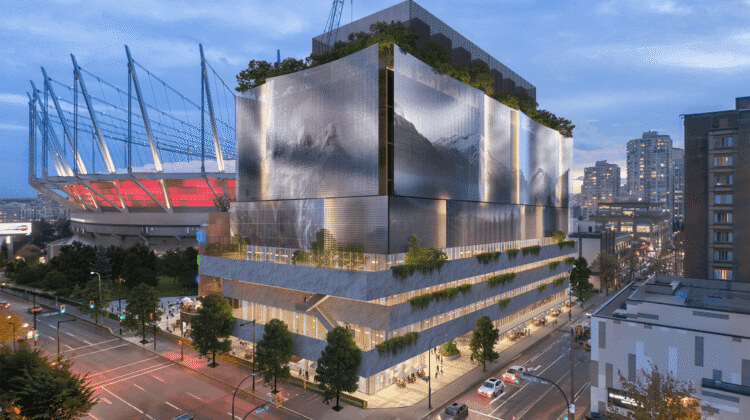
- Downtown Vancouver (150 West Georgia St.): A massive, 10-storey, 400,000-square-foot development adjacent to BC Place—projected to be the largest of the three sites with up to 100 MW of electrical capacity—scheduled to come online in 2029.
In their May releases, Telus and Westbank heavily promoted the projects as some of the world’s most sustainable data centres, noting they would run on 98 per cent renewable energy, use closed-loop liquid cooling to cut water consumption by 90 per cent, and feed recycled waste heat into the City of Vancouver’s Neighbourhood Energy Utility and Creative Energy’s downtown district energy system to help heat the equivalent of 150,000 homes.
Despite those sustainability pledges, the proposals quickly drew intense scrutiny from residents and advocacy groups such as No AI Data Centres in Vancouver. Throughout the summer, hundreds of protesters marched against the developments, raising alarms over heavy electricity and water demands, neighborhood disruption, and the allocation of prime urban land to server farms amid Vancouver’s ongoing housing crunch.
The pushback also spilled into municipal politics: Vancouver City Council deferred a rezoning decision on one of the sites until after the civic election, and a city councillor motion slated for November threatens to introduce stricter municipal rules, including mandatory independent environmental assessments and new fees for data centres.
With its Vancouver co-developments off the table, Telus stated that it will continue expanding its existing 215,000-square-foot data centre in Kamloops—which is set to come online later this year—while actively exploring alternative locations and partnerships to deliver sovereign AI compute capacity across Canada.