
SiteSummit: Unlocking AI’s financial potential
Construction tech experts say human trust and organized data are critical for AI.
Key Takeaways:
- While industries like logistics successfully use high-accuracy predictive AI to manage driver safety, the construction sector is lagging.
- Instead of chasing broad trends, AI adoption should focus on specific, costly issues like project delays, disputes, and physical rework. verify AI outputs—such as clicking an AI progress report to view the corresponding 3D site scan.
- The most effective approach is to start small: listen to employees’ needs, set clear guardrails, and give them a sandbox to experiment.
The Whole Story:
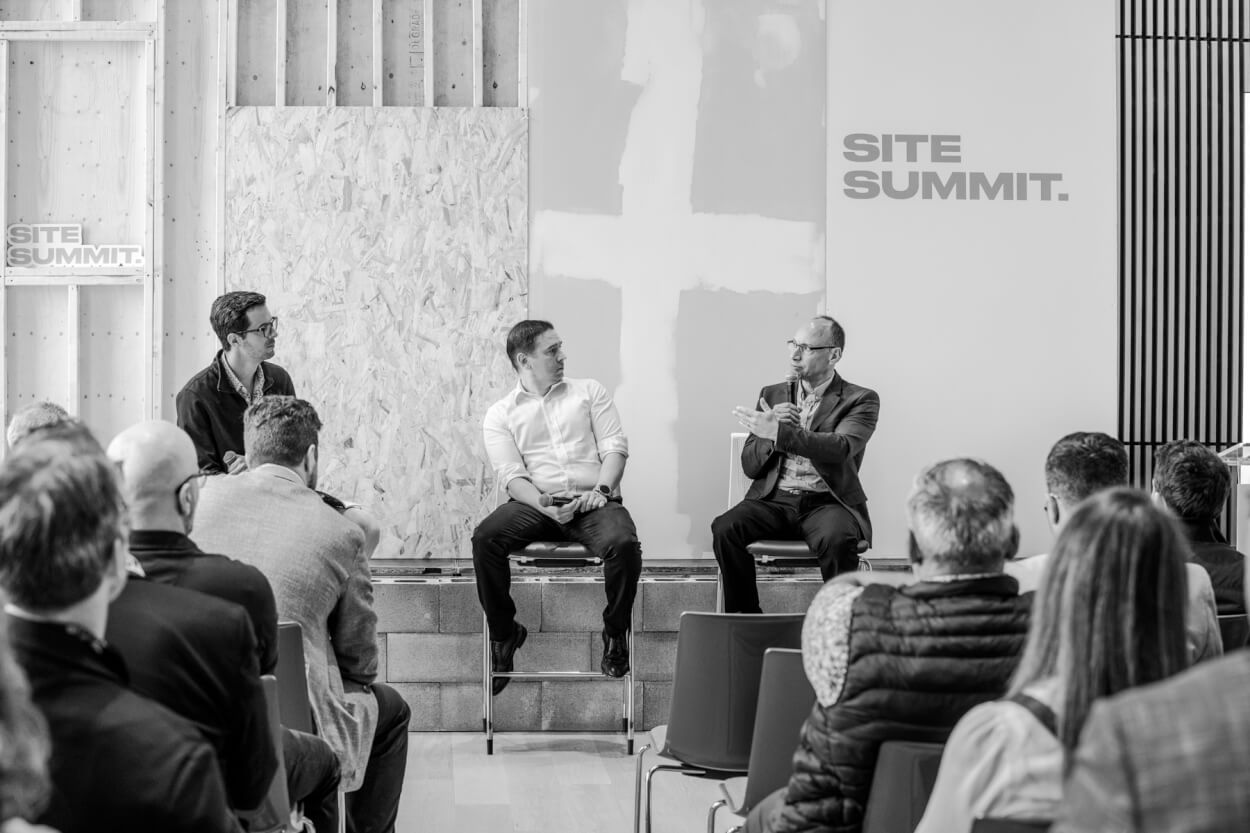
Trust and foundational data, not flashy public chatbots, are the real keys to unlocking the financial potential of artificial intelligence in the industrial and construction sectors, a panel of technology experts says.
Speaking at a recent industry roundtable, technology leaders emphasized that the shift from AI hype to actual profitability hinges entirely on human trust and the quality of underlying data.
“Prediction only becomes profit — or real — when a human trusts it,” said Andrew Viola, co-founder and vice-president of client success at SiteAI, who moderated the discussion. “And at the end of the day, that’s the battle we are in with AI: the trust you have with it to make a decision and trusting it enough to act on those results.”
David Swan, vice-president of off-highway at telematics giant Geotab, highlighted how predictive AI is already saving lives in logistics and transport, though it remains underutilized in construction.
For major fleets like Amazon and FedEx, Geotab’s predictive models can anticipate driver incidents with 97 per cent accuracy. The models are so reliable that these companies actively pull high-risk drivers off the road for retraining.
“They are willing to spend the money to stop business for that person because they believe with near certainty that the driver will get into an on-road accident within three months if they don’t retrain them,” Swan said. “On-road, people are living and dying by this predictive capability.”
By contrast, construction sites remain bogged down by poor data integration. Despite the fact that modern scissor lifts and heavy equipment have been equipped with sensors to track tilt, height, and load capacity since 2020, the sector has yet to fully leverage this information.
“The machine and asset data are certainly there to build these 97 per cent accurate predictive models, but what we haven’t done in construction is invest in the foundation and standardization of the data at the base layer to make it trustworthy,” Swan said.
Chuck Pfeffer, vice-president of partnerships at spatial intelligence platform Cupix, agreed that AI deployment must target concrete financial pain points rather than general trends. He pointed to rework, onsite disputes, and decision delays as prime targets.
“You need to solve the problems that are costing you money to increase the P and lower the L,” Pfeffer said, noting that labour, material, and time costs from rework are obvious starting points.
Pfeffer explained how reality capture — using 3D scans and drone imagery — can build onsite trust by linking visual progress directly to project schedules and Building Information Modelling (BIM) designs. If a site supervisor disputes an AI’s progress report, they can easily click the data point and inspect the visual history themselves.
“That is ‘trust but verify’ in construction,” Pfeffer said.
Panellists warned businesses against waiting too long to begin their AI journeys, but cautioned against common implementation mistakes, such as treating AI integration as a side project or “stretch assignment” for existing staff. Viola also noted that “shadow AI” — where employees use unauthorized tools — is likely already happening in companies that lack official policies.
Rather than overcomplicating a massive corporate strategy, Swan suggested starting small and giving capable employees a sandbox to experiment. He shared a story of a data science intern at Geotab who built a 99 per cent accurate edge-AI model to predict telehandler tasks in just a few weeks using a $200 camera.
“Take a smart person, give them domain-specific guardrails, and let them go crazy,” Swan said.
Looking to the future, the panellists predicted major advancements by 2028, including predictive safety models for heavy equipment operators and localized Large Language Models (LLMs) running securely within businesses.
Viola noted that Canadian companies do not need to risk proprietary data on public models like ChatGPT.
“You can disconnect an LLM and deploy it securely within your business with data residency in Canada,” Viola said. “It has all the power of the public models, but it only knows your business.”
When asked for a single piece of advice for businesses looking to move forward, the panellists urged simplicity and engagement.
“Establish that data foundation and move — just do it,” Pfeffer said.
Swan offered a simpler directive: “Listen.”
“When you listen to your staff and employees about what they think AI can do to help, the buy-in you get when you build it is awesome,” Swan said.