
SiteSummit: The psychology behind change management
Workers are more afraid of what they will lose than what will be different.
Key Takeaways:
- Canadian productivity growth has dropped from 3% to 1% since 2000 because organizations fail to make operational changes stick.
- To build momentum, management must shift individuals from denial to decision by providing clear purpose, operational mastery, and a sense of autonomy.
- Corporate transitions fail when organizations leave the legacy way of working easy to access.
The Whole Story:
Experts say Canadian organizations must master the human element of change management to reverse the country’s decades-long productivity stagnation.
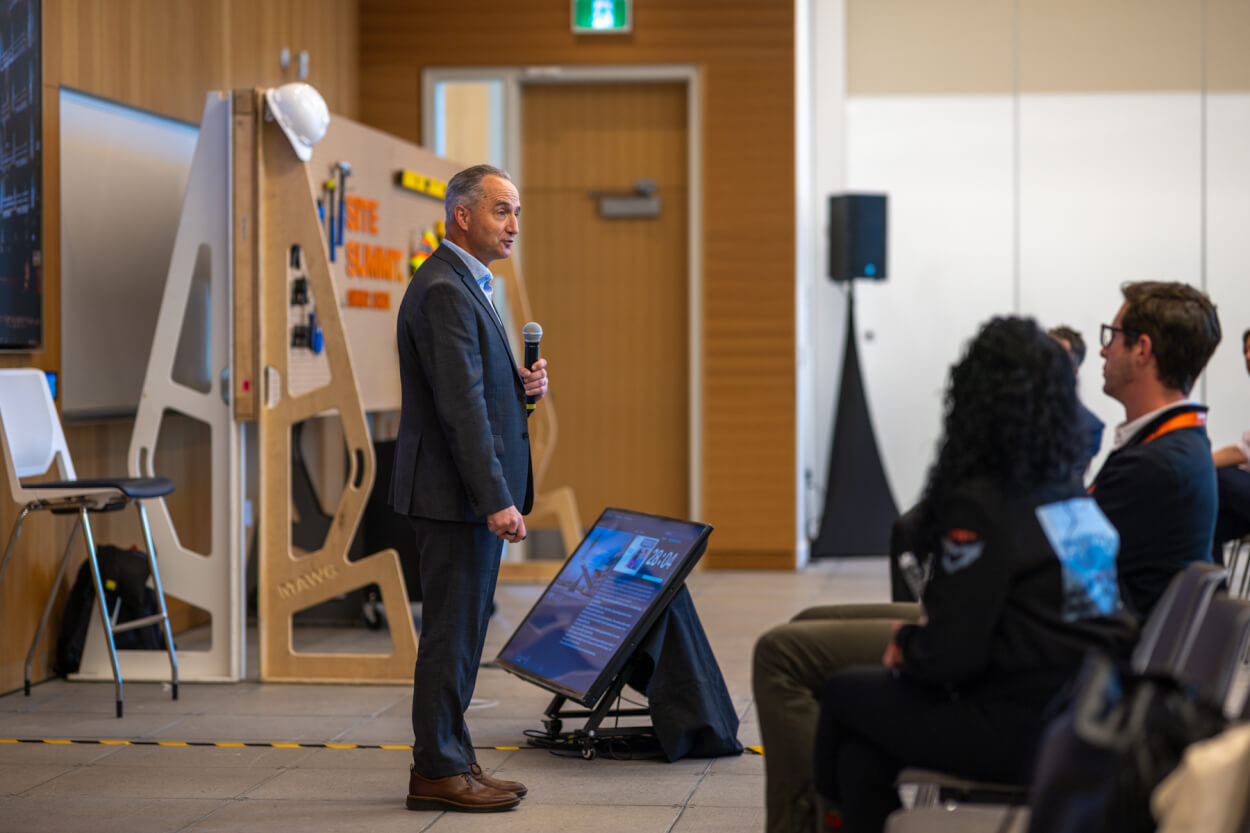
Sean Fitzgerald, partner and chief transformation officer at Results, told attendees at SiteSummit that the primary barrier to operational success is not the launch of a new strategy, but the gravitational pull of the familiar. He explained that corporate transitions often collapse because leaders fail to recognize what employees feel they are losing during a corporate shakeup.
“The leadership lesson for us is that people don’t resist change; they resist loss,” Fitzgerald said.
This failure to adapt has wider economic consequences for the country. Fitzgerald pointed to a dramatic slowdown in national output over the last several decades, noting that Canadian productivity growth has plummeted from a 3% rate in the 1960s and 1970s to just 1% since the year 2000. He argued that closing this gap requires organizations to stop treating change management as a soft skill and start viewing it as an essential business capability.
To make transitions stick, Fitzgerald said management must address both motivation and structure across individual, team, and organizational levels. At the individual scale, he cited the need to provide employees with clear purpose, operational mastery, and personal autonomy. He warned that simply assigning new responsibilities without backing them up with proper tools, training, and time will inevitably push staff into frustration and operational paralysis.
Shifting an entire group requires leveraging social proof and leadership authority. Fitzgerald illustrated this with a video experiment showing how individuals mimic the actions of a crowd to avoid feeling excluded, eventually turning a random behavior into a social norm. He said corporate leaders must actively tip the balance between early adopters and resisters to establish a new operational baseline.
The speech also highlighted the importance of identifying vital behaviors, which are the specific actions that determine a project’s success or failure. Using software deployments as an example, Fitzgerald noted that companies often buy complex systems without ensuring staff perform the baseline behavior of entering data. He added that corporate structures must be designed to make legacy methods difficult to access.
“The most common thing that I think people forget to do is to make the old way hard to do,” Fitzgerald said.
This breakdown is currently playing out in the technology sector, where massive sums are spent on artificial intelligence with minimal corporate return. Fitzgerald noted that only 25% of corporate AI initiatives currently demonstrate a return on investment, and a mere 16% successfully scale enterprise-wide. He concluded that regardless of how advanced a new technology is, it remains useless until an organization builds the collective habit to use it.
For more information about Result Business Consultants, visit their website.