
SiteSummit: The ‘new rules’ of industrial marketing
How to tell your company story in 2026.
Key Takeaways:
- Construction marketing teams must strategically pace and repeat key messages rather than attempting to promote every corporate division simultaneously.
- Authentic and unpolished content from active jobsites often generates more audience engagement than produced videos, provided the company retains control over its brand message.
- Modern industrial marketing needs to integrate with human resources and business development while demonstrating a clear return on investment through sales results.
The Whole Story:
The playbook for marketing in construction sector is changing and the industry leaders shared their secrets at this year’s SiteSummit conference in Toronto.
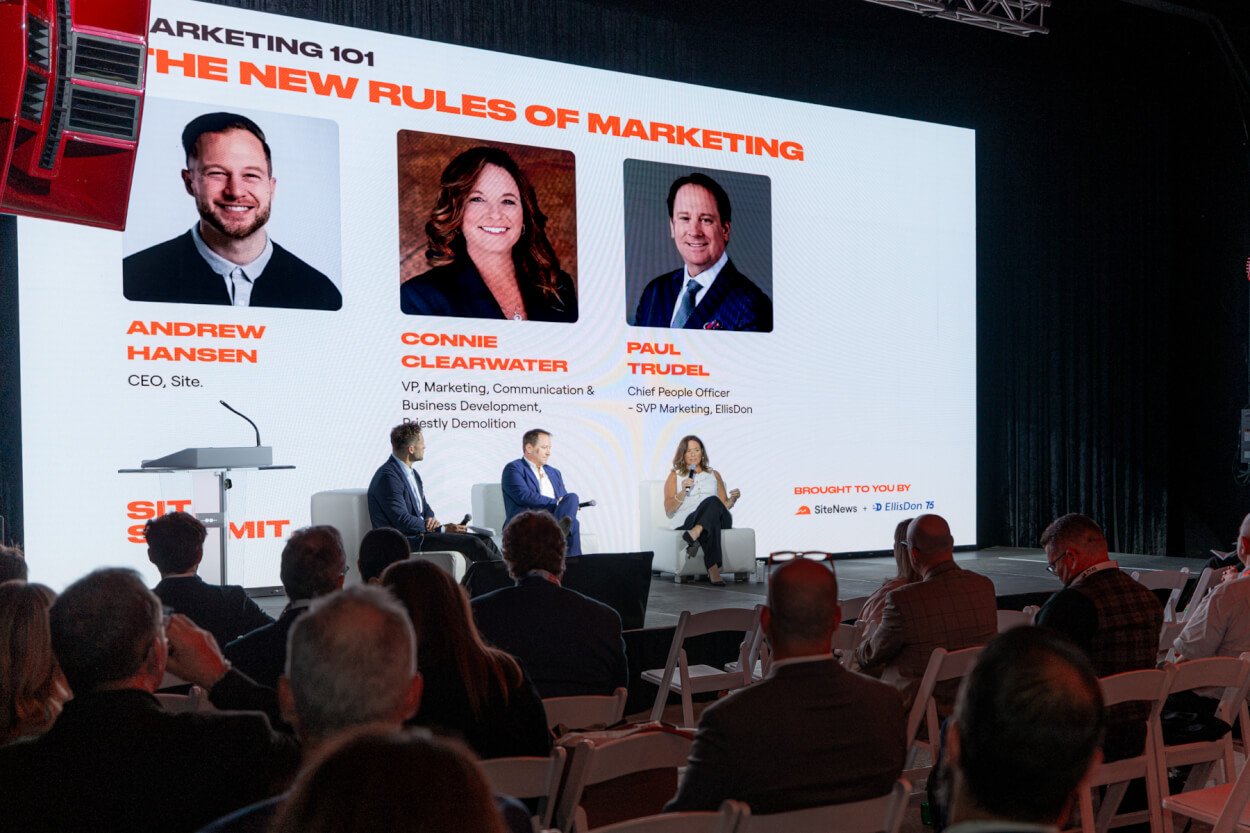
The “Marketing 101: The New Rules of Marketing” session Moderated by Andrew Hansen, Chief Executive Officer at Site, presented an honest discussion on how sector leaders must balance rigid brand consistency with bold, emotional, and authentic storytelling.
Cutting through the corporate noise
Panelists noted that the construction sector has historically struggled with a tendency to over-curate its image, often drowning out its most compelling messages. Addressing this operational challenge, Paul Trudel, Senior Vice President of Marketing at EllisDon, explained how the marketing team navigated intense internal pressures to promote every corporate division simultaneously.
“EllisDon does a lot of stuff, great,” said Trudel. “But if you’re screaming it all at the same level all the time, you’re not going to hear the most important things.”
To remedy this, the team aligned directly with business operations to pace their initiatives strategically, learning how to adjust their message “dials” from a ten down to a three or a four depending on corporate priorities. Paul further emphasized the value of repetition to cut through market static, stating, “If you don’t say something seven times they won’t remember. So we find seven different ways to say the same message over and over again.”
The power of grassroots authenticity
The conversation also focused value of unpolished, real-time storytelling directly from active jobsites. Connie Clearwater, Vice President of Marketing, Communications, and Business Development, argued that audiences are increasingly seeking true-to-life proof over glossy corporate advertisements.
“Don’t underestimate the value of what is happening in real time on those job sites,” Clearwater stated. “You would be surprised how those pieces of media can carry… those three photos that your super took on his iPhone actually got far more engagement than your large produced video.”
Clearwater pointed to the massive brand lift generated by Priestly’s mainstream reality television series, Salvage Kings, which successfully broadcasted across 44 countries. Crucially, Connie highlighted that the general public did not just connect with the heavy machinery, but with the actual people behind the stories. While demolition work requires strict internal review to guarantee safety compliance, showcasing authentic human expertise fostered unprecedented public trust. Paul strongly validated this push toward raw communication, adding flatly, “Nothing beats authenticity. Absolutely nothing.”
However, Clearwater noted that while the exposure of a reality show can be a huge boon to a company, it also carries massive reputational risk.
“We learned how important it is to control your brand and your message. Don’t let anybody else have control of that,” said Clearwater. “Exposure is wonderful, but if you can’t control it, or if your brand is compromised, that’s not a great thing.”
Aligning talent, expansion, and financial ROI
A major theme of the session was how industrial marketing can no longer operate in a silo. It must actively integrate with Human Resources and Business Development to fuel recruitment and regional expansion. For companies expanding into new geographic territories, local community investment and explicit corporate humility are mandatory to win over localized clients. Clearwater also noted that direct marketing campaigns have emerged as an underrated, highly effective tool to re-engage past clients and spark in-person meetings.
The panel concluded that marketing’s seat at the executive table is secured by tying creative energy directly back to the company’s bottom line. Andrew Hansen wrapped up the session by emphasizing that brand investment must protect price and demonstrate business performance.
“If you can tie those activities and that energy into sales results and wins and protecting price,” Hansen concluded, “that marketing investment for next year gets pretty easy.”