
Premiers unveil west-to-east pipeline proposal
The proposed route would stretch from Hardisty, Alberta to Sarnia, Ontario.
Key Takeaways:
- Alberta and Ontario have launched the Northern Shield Energy Corridor, a 3,300-kilometre crude oil pipeline routing from Hardisty to Sarnia.
- The all-Canadian line will transport 500,000 barrels of oil per day, with the physical scalability to expand up to 800,000 barrels per day.
- The pipeline will supply Ontario refineries, anchor a potential strategic petroleum reserve, and explore maritime export extensions to the Port of Churchill.
The Whole Story:
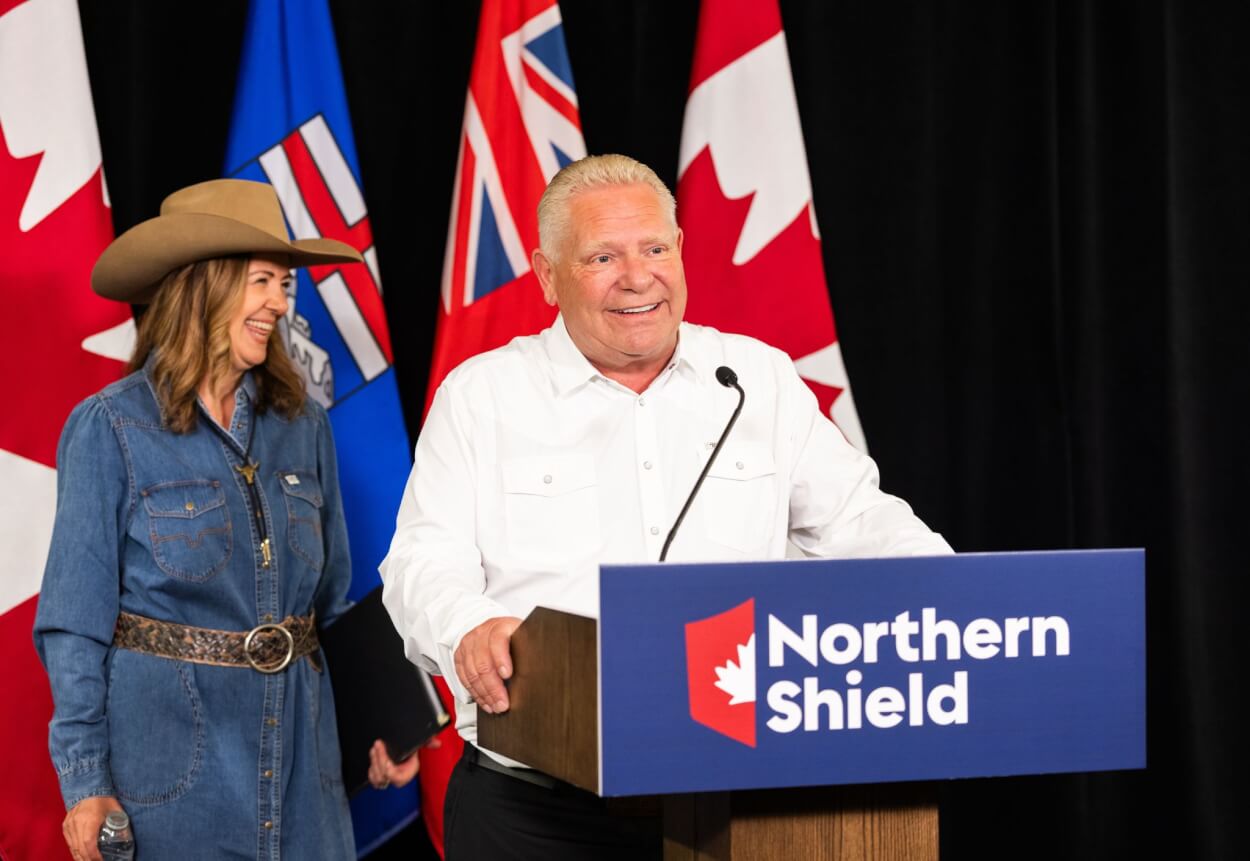
Ontario Premier Doug Ford and Alberta Premier Danielle Smith joined forces to unveil the proposed route for the Northern Shield Energy Corridor, an ambitious 3,300-kilometre west-to-east crude oil pipeline. Framed as an all-Canadian “nation-building” initiative, the proposed corridor is engineered to insulate the country from unstable foreign energy markets and reduce heavy reliance on transit routes through the United States.
The primary route under evaluation stretches from the major oil-storage and pipeline hub of Hardisty, Alberta, traveling past Regina and Winnipeg, before terminating at the central refining cluster in Sarnia, Ontario. By maintaining a footprint exclusively within domestic borders, the project provides a legal and physical alternative to cross-border lines like Enbridge’s Line 5. The pipeline is designed to transport an initial 500,000 barrels of oil per day (bpd) to serve domestic refining and export markets, with built-in structural engineering capacity to scale up to 800,000 bpd in subsequent phases.
The multi-provincial corridor operates under a broader joint Memorandum of Understanding signed between Alberta, Saskatchewan, and Ontario, which focuses on long-term supply chain security, trade infrastructure, and nuclear energy integration. While the core path travels to Sarnia, Ontario is concurrently assessing extensions to maritime ports to establish new tidewater pathways for global export. The proposed layout also presents a strategic opportunity for the Government of Manitoba and the Manitoba-Crown Indigenous Corporation to investigate a secondary northern pipeline extension feeding the Port of Churchill.
Ontario is currently executing a detailed project assessment to outline structural baseline costs, evaluate private-public commercial models, and study the integration of localized electrical grid upgrades alongside a potential strategic petroleum reserve. The province has also launched its formal duty to consult with Indigenous communities, backing the process with targeted funding to facilitate First Nations equity partnerships in the asset. The full comprehensive feasibility study is slated for completion by the end of 2026.
“Our plan to build the Northern Shield Energy Corridor is a plan to protect workers in Ontario, Alberta and every part of the country,” said Ford. “We’re going to keep working to build a more secure, united and resilient Canadian economy, so we can keep Canadian workers on the job, make life more affordable for Canadian families and help get Canadian energy to new markets across the country and around the world.”
Northern Shield Project Advisory Matrix
Infrastructure Ontario is serving as the lead Commercial Advisor to oversee a multidisciplinary private-sector team tasked with completing the 2026 feasibility rollout:
- Commercial Oversight: Infrastructure Ontario (IO)
- Financial & Business Modeling: Ernst & Young LLP (EY Canada)
- Indigenous Engagement & Strategy: Mokwateh
- Engineering & Technical Design: AtkinsRéalis Group Inc., Wood PLC, and GHD Limited
- Project Management & Cost Controls: Turner & Townsend Limited