
Industry groups support bill to abolish B.C.’s union mandates
The law would prohibit government from requiring union or non-union affiliation for bidders on construction projects.
Key Takeaways:
- The proposed legislation would stop the provincial government from making union membership a requirement for companies bidding on large infrastructure projects.
- While the bill has support from major construction associations for promoting competition it is unlikely to pass because of the current government majority.
- Opponents of the bill argue that the existing framework is necessary to ensure that the majority of work hours are completed by local residents and apprentices.
The Whole Story:
A new private member’s bill introduced in the British Columbia legislature last month aims to reverse B.C.’s Community Benefits Agreement policy.
If passed, the Conservative bill would prohibit public sector entities from requiring union or non-union affiliation as a condition for bidding on government construction projects.
The Public Sector Construction Projects Procurement Act would ensure that a vendor’s labour status cannot be used as an evaluation criterion for projects involving major public works like bridges, roads, and pipelines.
Under the act, government bodies are also barred from requiring non-unionized contractors to pay union dues or fees in lieu of dues, a move intended to foster open competition across the province’s construction sector. While the rules would not retroactively affect existing contracts, the bill effectively prevents any future agreements that would mandate collective bargaining as a prerequisite for provincial work.
Introduced last month by Prince George-Mackenzie MLA Kiel Giddens as a private member’s bill, it has little chance of passing with the province’s current NDP majority. In fact, only two such bills have passed in the province’s history.
Despite this, it has seen support from some major industry groups, notably garnering an endorsement from the Independent Contractors and Businesses Association (ICBA), Canada’s largest construction association.
“With no end in sight to B.C.’s deficits and debt, the last thing we should be doing is driving up government costs by limiting the pool of qualified contractors and workers who can bid on public work,” said Chris Gardner, ICBA President and CEO, noting that less than 15% of construction workers in B.C. are affiliated with the building trades unions. “By freezing out workers who are not unionized, or are members of progressive unions or employee associations, the NDP Government is denying workers and contractors fair opportunities to bid and win work, wasting taxpayer dollars, and delaying the delivery of new infrastructure for the public when people need it.”
The BC Construction Association also chimed in on the bill, saying it has a long history of advocating for fair and open public procurement.
“Publicly funded infrastructure projects should be accessible to all qualified participants in the construction sector, regardless of labour affiliation,” said the group in a statement. “At a time when BC is facing significant skilled labour shortages, it is especially important that governments do not limit who can participate in building critical public infrastructure.”
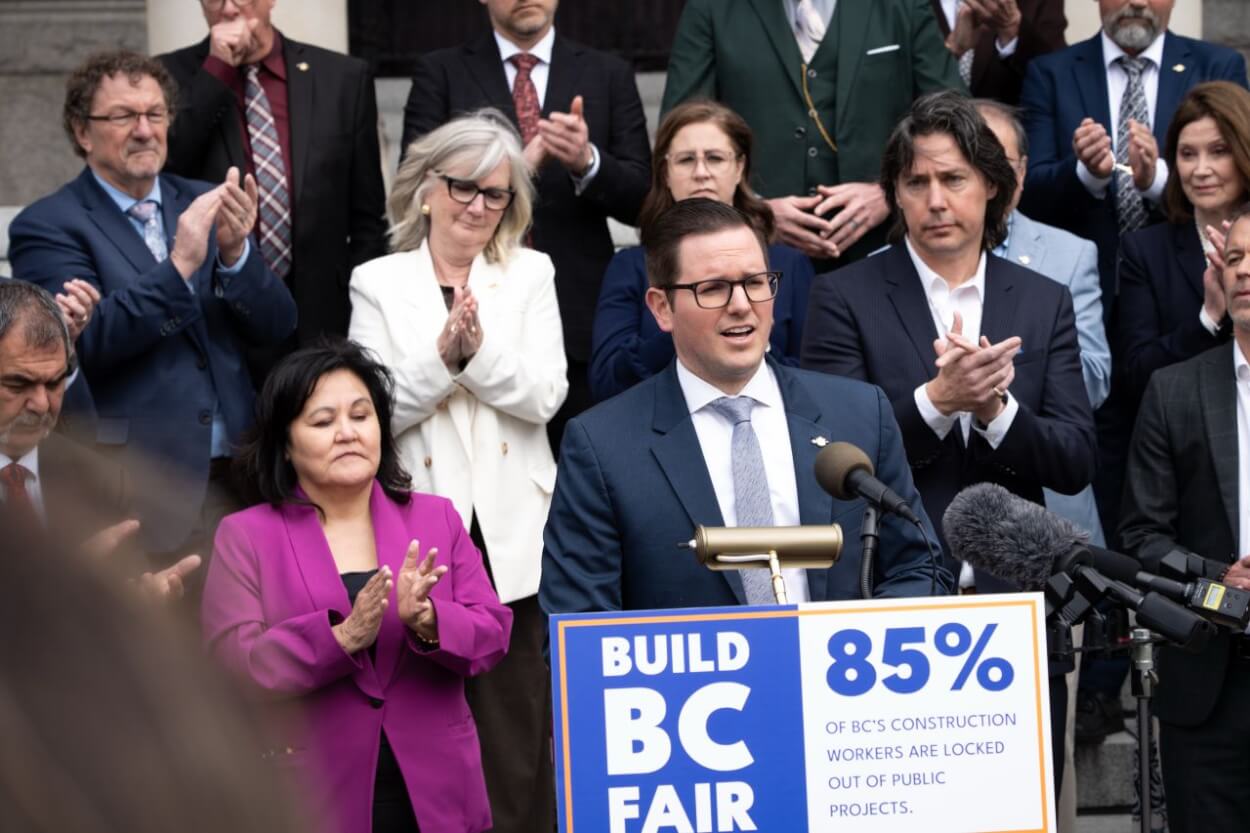
However, not all were impressed. This month union advocates called the bill an attack on jobs and delivered a 2,600+ signature petition urging the BC Conservatives to withdraw it.
“The BC Conservatives’ bill is nothing short of an attack on good-paying local jobs that support families and communities. We’re here in Victoria today, calling on MLAs to vote against this harmful bill,” said Brynn Bourke, Executive Director for the BC Building Trades. “British Columbians, especially those in the skilled trades, expect public infrastructure projects to prioritize local hiring, create apprenticeship opportunities for young people, and deliver family-supporting wages.”
She stated that on CBA projects, 94% of project hours have been worked by B.C. residents, and more than 1,550 trainees and apprentices have been employed.
“That’s in stark contrast to the old way of doing business when labour was sourced outside B.C. through the Temporary Foreign Worker program and job sites were full of out-of-province license plates,” she said.
What role unions should play in the procurement process for B.C.’s major projects is a debate that has been ongoing for years. B.C.’s CBA was introduced on July 16, 2018, by Premier John Horgan’s NDP government to manage labour on major provincial infrastructure projects. The framework established a new Crown corporation, British Columbia Infrastructure Benefits Inc. (BCIB), to act as the employer of record for workers on designated projects, such as the Pattullo Bridge replacement and Trans-Canada Highway four-laning.
By signing a collective agreement, the province mandated that all site workers join a union to prioritize local hiring and create training opportunities for Indigenous people, women, and apprentices.
B.C. isn’t the only province drawing criticism from industry groups for its job agreements. Manitoba recently introduced a “hybrid” model that guarantees union-scale wages and benefits for all workers to ensure labor stability, but explicitly does not require non-union employees to join a union.
The Manitoba Jobs Agreement (MJA) was officially established in September 2025 to govern public infrastructure projects exceeding $50 million. The agreement functions as a provincial policy that mandates standardized union-scale wages and benefits for all workers while explicitly allowing non-union contractors to remain “open-shop.”
However, a central and controversial feature of this timeline is the implementation of a $0.85 per worker, per hour surcharge, which contractors must pay directly to the Manitoba Building Trades coalition. While the government justifies this fee as a vital investment in the provincial apprenticeship and training pipeline, industry groups have criticized it as a “hidden tax” on non-union labor, leading to calls in early 2026 for an Auditor General investigation into its transparency and impact on taxpayer costs.